






Key Takeaways
- Roadmap aligns teams, timelines, and ownership.
- Usage-based rules beat vanity marketing signals.
- PQL models reveal accounts already seeing value.
- Decay and negatives keep scores honest.
- Prove lift first, then scale confidently.
- Measure KPIs; tune thresholds by segment.
Imagine your sales team knowing exactly when a prospect is ready to buy—backed by a clear set of lead scoring implementation roadmap steps that turn product usage into a signal you can trust. In a product-led world, your software is the loudest buying signal. Why does traditional lead scoring fail here? Because it still rewards form fills and job titles over the behaviors that prove value realization inside the product. The result: real prospects slip through while reps chase leads that look good on paper but haven’t experienced your core value.
The fix isn’t another tweak to demographic points—it’s a usage-driven scoring model that treats engagement milestones as your primary qualification signal. When marketing, sales, and product align on the same behavioral thresholds, you unlock faster sales cycles, higher conversion rates, and more predictable revenue that scales with adoption. This post maps the phased journey to that ideal state and answers the practical questions SaaS leaders face when shifting from legacy scoring to product-centric qualification.
What are the lead scoring implementation roadmap steps every SaaS team should follow?
Rolling out product-led lead scoring doesn’t have to be overwhelming. A roadmap gives structure to the process, ensuring teams don’t get lost in scattered data or conflicting priorities. Each phase builds on the previous one—moving from understanding your current state, to equipping your systems, to validating performance. By breaking the journey into manageable steps, SaaS teams can build confidence and reduce risk while still moving quickly toward measurable business impact.
Phase 1: Audit & Alignment
This is your discovery stage. Take inventory of what exists today: What scoring rules are already in place? Which product analytics events are available? Where are the gaps? Just as importantly, use this phase to align stakeholders—marketing, sales, and product—around shared activation and engagement milestones. This ensures everyone is scoring toward the same definition of readiness.
Phase 2: Instrumentation & Integration
Once the gaps are clear, focus on building the plumbing. Instrument missing product events in your analytics tool, and double-check the accuracy of existing tracking. Then, integrate those signals into your CRM or marketing automation system so they flow seamlessly into the scoring engine. This is where technical precision matters, because flawed data upstream will undermine the entire model downstream.
Phase 3: Calibration & Rollout
Here you bring the model to life. Configure scoring rules and establish decay schedules so scores stay dynamic. Set alerts and thresholds for high-value leads, ensuring sales teams are notified in real time. Start with a controlled pilot, tracking the lift in MQL to SQL conversions and gathering AE feedback. Once the pilot proves value, expand to a full rollout—scaling rules, refining thresholds, and continuously tuning performance.
How long does it take to implement a lead scoring model in practice?
Timeframes vary by company size and data maturity, but most SaaS teams can expect a 30–60 days path from audit to rollout:
- Weeks 1–2: Audit signals, align stakeholders, and finalize roadmap.
- Weeks 3–4: Instrument events, connect CRM/automation platforms.
- Weeks 5–6: Run pilot scoring model, track results, and refine.
Keeping the timeline realistic builds trust across teams and sets expectations for iteration rather than perfection on day one.
What usage-based lead scoring rules and best practices should SaaS teams adopt?
Usage signals are more reliable than vanity metrics like email opens. Best practices include:
- Assign higher points for recurring feature use over time, not one-off clicks.
- Include negative scoring for inactivity or uninstall events.
- Decay points over time to avoid inflated scores from old activity.
- Calibrate weights with sales feedback to avoid false positives.
This ensures that lead scores reflect true product adoption and buying readiness.
How do you build a PQL model that actually works?
A product-qualified lead (PQL) model translates in-product actions into sales readiness. To build one:
- Define activation milestones (e.g., first team invite, core feature use). These are the specific product behaviors that show users are getting value and moving closer to a purchase decision.
- Assign point values that align with revenue likelihood. Weight the milestones so that stronger buying signals (like integrations or multiple teams invites) carry more influence than lighter actions.
- Layer usage signals with firmographic or demographic data for context. This helps you understand not just what the user is doing, but who they are—ensuring your model is relevant to both SMB and enterprise prospects.
- Continuously test and refine based on SQL conversion performance. Track how well your scoring predicts real opportunities, then adjust point values, thresholds, or decay rules to keep accuracy high.
The result is a scoring system that surfaces prospects who are already realizing value from your product.
Why is product-led lead scoring important for B2B enterprises?
In B2B enterprise SaaS, the buying process involves multiple stakeholders. Product-led lead scoring helps by:
- Identifying champions who actively use the product.
- Highlighting accounts where multiple users engage across departments.
- Alerting sales teams when enterprise usage patterns suggest cross-sell or upsell opportunities.
For enterprises, product-led scoring bridges the gap between individual usage and account-level readiness.
How do usage signals vs profile signals impact PQL accuracy?
While profile signals (job title, company size) are helpful, usage signals are more predictive of revenue outcomes. The best models:
- Use profile data to set context (e.g., SMB vs enterprise thresholds).
- Prioritize usage signals such as repeat core feature use, integrations, or pricing page visits.
- Combine the two for a balanced approach that avoids overreliance on either data type.
This hybrid approach ensures your PQL model balances precision with scale.
What does a product-qualified lead model look like for SaaS trial users?
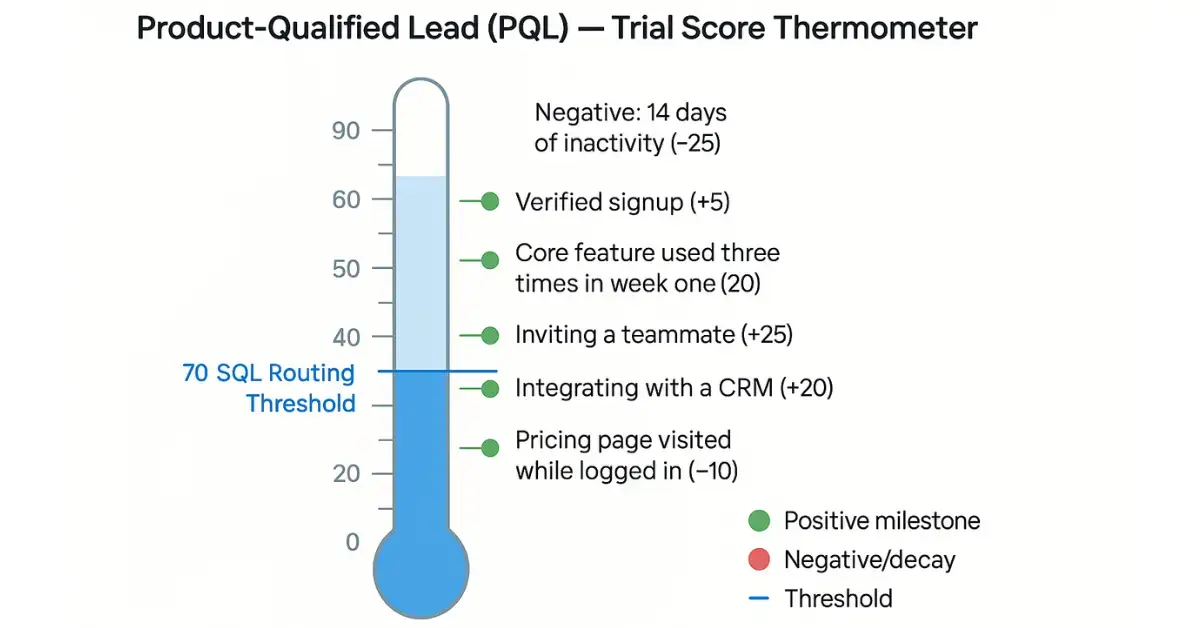
Trial users are one of the strongest PLG signals. A PQL model for trials might include:
- Account creation with verified email (+5 points).
- Core feature used three times in the first week (+20 points).
- Inviting a teammate (+25 points).
- Integrating with a CRM (+20 points).
- Visiting pricing page while logged in (+10 points).
- Negative: 14 days of inactivity (−25 points).
These scoring steps help identify which trial accounts are worth immediate sales engagement.
How do you measure success and avoid pitfalls in product-led lead scoring?
Success in product-led lead scoring isn’t just about putting a model in place—it’s about proving that the model reliably drives better business outcomes. To do this, focus on a mix of conversion, efficiency, and accuracy metrics:
- Lift in MQL to SQL conversion rate. Track whether leads routed by the scoring model convert more often than those routed by traditional methods.
- Time-to-first-sales-touch. Measure how much faster your sales team engages once high-value usage signals trigger alerts.
- Win rate for PQLs vs MQLs. Compare how often product-qualified leads close compared to marketing-qualified leads.
- Pipeline contribution. Assess how much of your pipeline is generated from PQLs and whether it is growing month over month.
- Feedback loop accuracy. Collect AE and SDR feedback on routed leads to validate whether scores match ground truth.
At the same time, watch out for common pitfalls:
- Overvaluing vanity metrics. Email opens and page visits rarely predict purchase on their own.
- Ignoring score decay. Without decays, inactive users may appear hotter than they are.
- One-size-fits-all thresholds. Different segments (SMB vs enterprise) often need different benchmarks.
- Failing to validate with real outcomes. A model is only useful if its high scores consistently map to revenue.
By regularly reviewing these KPIs and correcting for pitfalls, you ensure that your scoring system remains accurate, scalable, and trusted by both marketing and sales.
Frequently Asked Questions (FAQs)
u003cstrongu003eHow do I apply lead scoring implementation roadmap steps in a US B2B SaaS context?u003c/strongu003e
Start with a quick audit (signals, gaps, owners), then instrument priority events and connect them to CRM/MA for real-time scoring. Pilot with one US segment first to validate routing and SLAs before scaling.
u003cstrongu003eHow long does it take to implement a lead scoring model for most SaaS teams?u003c/strongu003e
Most teams ship a first version in 30–60 days. Weeks 1–2 focus on audit/alignment, weeks 3–4 on instrumentation/integration, and weeks 5–6 on piloting and tuning with sales feedback.
u003cstrongu003eWhat usage-based lead scoring rules best practices should we follow to avoid vanity metrics?u003c/strongu003e
Prioritize repeated core-feature use over clicks, include negative points for inactivity, apply time-based decay, and set thresholds by segment. Pair alerts with talk-tracks so sales acts on real intent—not noise.
u003cstrongu003eHow to build PQL model that works for enterprises—and why product-led lead scoring for B2B enterprises matters?u003c/strongu003e
Define activation milestones at user and account level (e.g., multi-seat activity, integrations, pricing-page visits). Weight events that signal consensus and expansion, then validate with AE feedback from complex deals.
u003cstrongu003eDo usage signals vs profile signals for PQLs matter more for accuracy?u003c/strongu003e
Usage signals are stronger predictors of revenue. Use profile data to set context (SMB vs enterprise), but route primarily on recency, frequency, and depth of product behavior to minimize false positives.
u003cstrongu003eWhat does a product-qualified lead model for SaaS trial users include—and how do we act on it?u003c/strongu003e
Examples: verified signup, repeat core-feature use, teammate invites, key integration, and logged-in pricing visits—offset by inactivity decay. Route trials that cross threshold to sales with usage context attached.
Conclusion
If your pipeline still relies on gut feel and static fields, you’re not alone—and you’re not stuck. A product‑led approach simply meets buyers where the real intent lives: inside your product. Start with small, confident moves, follow clear lead scoring implementation roadmap steps, and let data from real usage guide the next tweak.
Our take is simple: prove lift first, then scale. Ship a pilot, listen to sales, tighten decay, and promote the signals that actually predict revenue. When the model earns trust, everything downstream moves faster—routing, conversations, and deals. Want a hand getting there? 4Thought Marketing can help instrument events, configure a scoring blueprint, and run a 60‑day pilot that shows measurable impact before you roll it out broadly. Let’s turn product behavior into sales‑ready moments—without the guesswork.